Separate keeping from making
A room used to mature cheese is not simply a warmer version of a refrigerator. Affinage involves product-specific processes, trained judgement and a food-safety system suited to the activity. A tasting venue that receives finished cheese usually needs reliable storage, hygienic preparation and controlled service instead. State which operation you are designing before specifying equipment. Otherwise a romantic reference to a cave can become an unsafe assumption about acceptable temperature.
Ask suppliers for written instructions for each product and packaging state. A whole, intact cheese and a cut portion may have different requirements. Fresh products such as Mozzarella di Bufala Campana should not inherit the conditions chosen for a hard wheel of Parmigiano Reggiano. Taleggio, with its surface-ripened character, introduces another handling context. Regional identity helps explain the collection, but it cannot replace the instructions attached to the actual delivery.
Start with the food-safety framework
The UK Food Standards Agency advises setting a refrigerator at 5°C or below to help keep chilled food within safe limits. Its business guidance states that cold food must be kept at 8°C or below in England, Wales and Northern Ireland, subject to applicable rules and exceptions. These figures are not a universal specification for all cheese maturation. They belong to a chilled-food safety context, and the distinction must remain visible in a project brief.
Discuss the proposed operation with the relevant local authority and a competent food-safety professional. A food business needs procedures based on hazard analysis and critical control point principles, commonly called HACCP. Codex Alimentarius provides an international foundation for those principles. A consultant’s display setpoint is not a substitute for identifying hazards, validating controls and deciding what staff must do when a check fails.
Measure where the collection lives
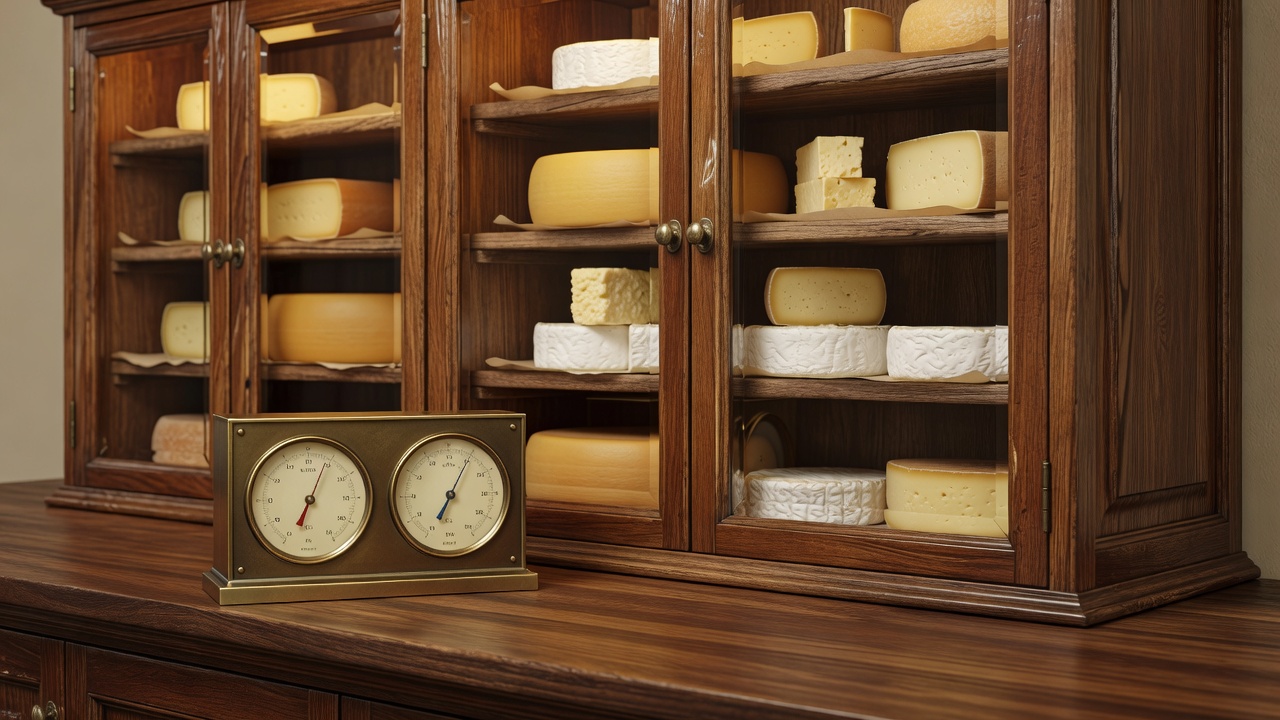
A display on the outside of a cabinet is useful, but it may not describe every shelf. Door openings, lighting, loading patterns and blocked air paths can create uneven conditions. Commission the equipment with a realistic load and agree a monitoring method with the operator. Place sensors where they answer a defined question, and keep the record understandable enough that someone will actually review it during a busy shift.
Specify how instruments will be checked for accuracy, who receives an alarm and what happens outside opening hours. A beautiful cabinet with an unheard alarm is a weak system. Consider power interruption, refrigeration failure and the safe isolation of affected stock. Make space for records and maintenance access in the architectural plan rather than leaving them to be squeezed behind the counter after installation.
Humidity is not a single magic number
Different rinds and packaging systems respond differently to moisture. There is no responsible universal relative-humidity target for every regional cheese collection. Establish the requirement for the intended stock with its supplier or a qualified specialist, then check whether the proposed cabinet can maintain it without condensation, uncontrolled mould growth or building-fabric problems. A humid maturation space is a specialist installation, not a decorative mist effect.
Ventilation and moisture control also affect the surrounding room. Warm air meeting cold glass can obscure the collection and wet adjacent surfaces. Locate supply air, cabinet exhausts and lighting with the equipment designer. Do not put a tasting seat in a draught merely to preserve a clean elevation. Acoustic comfort matters too: refrigeration noise that is acceptable in a store can interrupt a quiet guided tasting.
Plan the transfer to the table
Some cheeses reveal aroma and texture differently as they warm, but sensory preference does not establish a safe exposure period. Plan service quantities and timing within the operator’s food-safety procedures. Bring out manageable batches, retain identification and keep records where required. Do not repeatedly return exposed tasting leftovers to the main collection without a justified procedure.
Roquefort-sur-Soulzon and the ripening traditions associated with Normandy’s Camembert offer rich stories for visitors. Tell those stories without implying that a public tasting room reproduces the controlled production environments behind them. The most convincing architecture makes the distinction clear: a measured place for keeping, a clean place for preparing and a comfortable place for conversation.