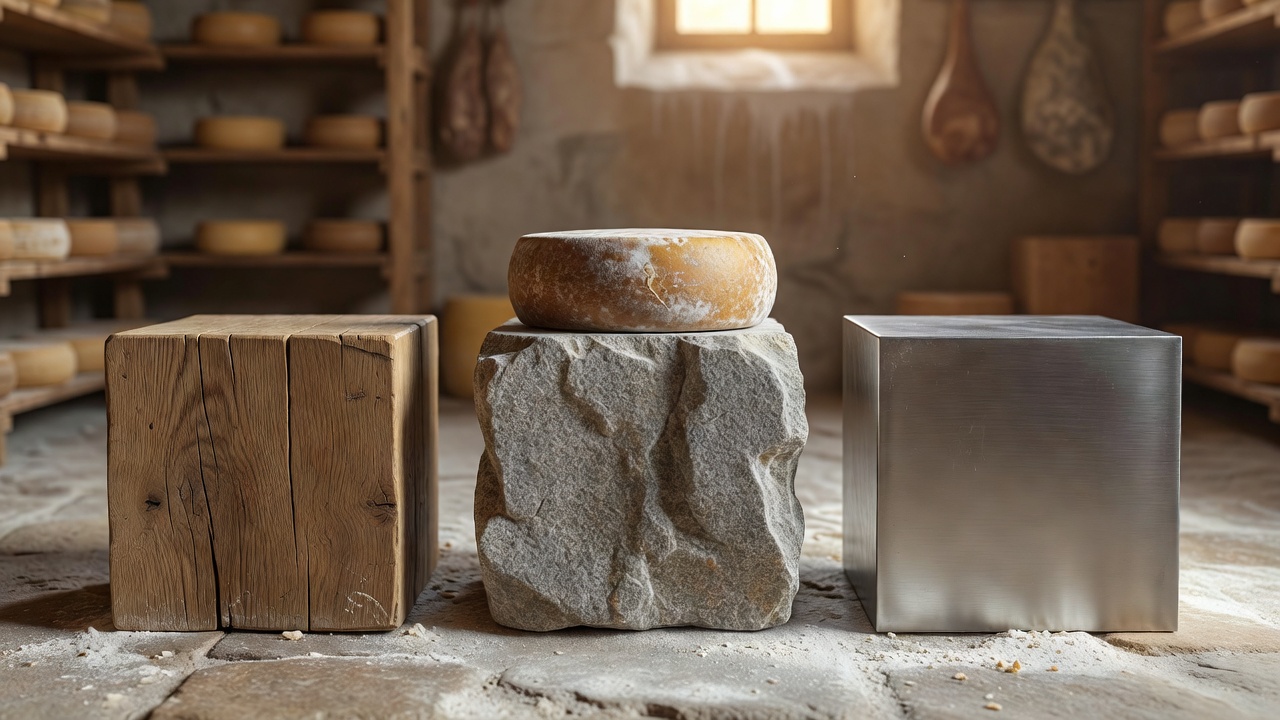
Name the contact condition
Before choosing a finish, distinguish direct food contact, splash exposure, hand contact and purely visual background. A wall behind a glazed cabinet has a different task from a board used to portion cheese. Treating the entire room as one material problem either over-specifies the decorative areas or under-specifies the working ones. Mark these conditions on drawings so that the operator, contractor and equipment supplier share the same understanding.
In the European Union, Regulation (EC) No 1935/2004 establishes a framework for materials and articles intended to contact food. Regulation (EC) No 852/2004 addresses food hygiene, including requirements relevant to premises and surfaces. The applicable UK framework must be checked separately for a UK project. These references are starting points, not a certificate that any timber, stone or metal product is suitable simply because its material family sounds familiar.
Timber: warmth with a maintenance question
Timber gives shelving a legible rhythm and connects naturally with the imagery of traditional cheese maturation. That association is not enough to approve a particular board or shelf. Species, construction, finish, intended contact, moisture exposure and cleaning method all matter. A specialist maturation operation may use timber under controlled procedures; a public tasting venue should not borrow that precedent without understanding the operating system behind it.
Ask how components will be inspected, removed, dried and replaced. Avoid inaccessible joints that trap residue. If timber is used only outside the food-contact zone, record that boundary clearly so that staff do not gradually turn a decorative ledge into a preparation surface. The honest use of timber can be more convincing than an all-over rustic finish that is difficult to maintain.
Stone: visual mass is not refrigeration
A stone plinth can give the room a calm centre and a sense of permanence. Its cool feel is a sensory property, not evidence that it maintains safe food temperatures. Do not describe a stone tasting table as refrigerated unless it is part of an engineered, validated system. Porosity, sealants, staining, edge details and joints deserve attention before a sample is approved for direct contact.
Consider the full assembly. A heavy slab requires adequate support, safe installation and a replacement strategy. A fine crack or open joint can be more important operationally than the beauty of the face. Obtain relevant supplier documentation for the intended use and cleaning chemicals. Place sacrificial or removable serving elements where they make hygiene and repair easier without turning the table into a collection of improvised mats.
Metal and glass: inspectable, not effortless
Suitable stainless-steel preparation surfaces can be durable and easy to inspect, but fabrication quality is decisive. Check seams, edges, supports and junctions with equipment. A reflective finish may produce glare under task lighting, while a thin unsupported panel can be noisy. Give the fabricator a performance brief rather than a photograph, and confirm the cleaning regime before selecting a surface treatment.
Glass allows a collection to be seen while limiting casual handling. It also reveals fingerprints, condensation and dust. Plan access to both faces, safe replacement and the movement of doors. Specify glazing and hardware appropriate to the location, loads and applicable building requirements. A frameless appearance is not a reason to omit the joints and tolerances that make the enclosure safe and maintainable.
Bring the building fabric into the conversation
A humid or refrigerated enclosure affects adjacent materials. Coordinate vapour control, insulation, drainage where needed and thermal bridges with the relevant designers. A cabinet installed tightly against a historic wall may create maintenance and moisture problems that are invisible in a front elevation. Provide access and inspection space rather than assuming that a neat fit is always the best detail.
Floors must respond to the expected contamination, cleaning and traffic. Choose slip performance for the real conditions, not merely an attractive texture. Strong texture can complicate cleaning and wheeled movement; a polished finish can behave differently when wet. Transitions should avoid unnecessary trip points and support accessible circulation. Have the specification reviewed against local requirements and the operator’s cleaning procedure.
Test a working corner
Build or mock up the most demanding junction: perhaps the cabinet door beside the preparation bench, or the tasting plinth beside the collection return route. Ask staff to clean it, reach the fixings and move the intended trays through it. Test label visibility under the actual lighting. These exercises often reveal more than another round of material swatches.
The final material schedule should include use, relevant documentation, cleaning method, inspection points and replacement responsibility. ISO 22000 offers a food-safety management framework, not a finish-selection catalogue; certification claims should be checked for their actual scope. The best room makes its working logic visible. Warmth and precision need not compete when every surface has a defined job.