Begin with an unhurried arrival
Visitors should understand where to put a coat, where to wash their hands and where the tasting begins without walking through a preparation area. Give the host a place to greet people without blocking the entrance. A small room benefits from this clarity more than from an elaborate reception counter. The first architectural task is to remove uncertainty, allowing attention to move toward the collection.
Offer seating choices and keep the principal experience available from a seated position. A standing island can look sociable while excluding people who cannot remain on their feet. Review reach, knee space, circulation and sanitary facilities with an access professional and the applicable local requirements. The Centre for Accessible Environments is a useful starting point for inclusive-design thinking; a generic dimension copied from a photograph is not.
Make ingredients and choices legible
Milk is an allergen, and accompaniments can introduce others, including cereals containing gluten or nuts. Keep accurate ingredient information available and train the host to answer from records, not memory. Cheese may also contain animal rennet or other ingredients relevant to a visitor’s dietary choices. Do not equate a vegetarian label with suitability for milk allergy, and do not assume that removing a cracker solves cross-contact.
Some visitors need additional food-safety advice because of pregnancy, age or health conditions. The NHS publishes guidance on foods to avoid in pregnancy, including distinctions among cheeses and preparation methods. Refer people to current authoritative advice rather than improvising reassurance at the table. It is hospitable to offer a clear alternative or to acknowledge that the tasting cannot meet a particular need safely.
Build a sequence around a question
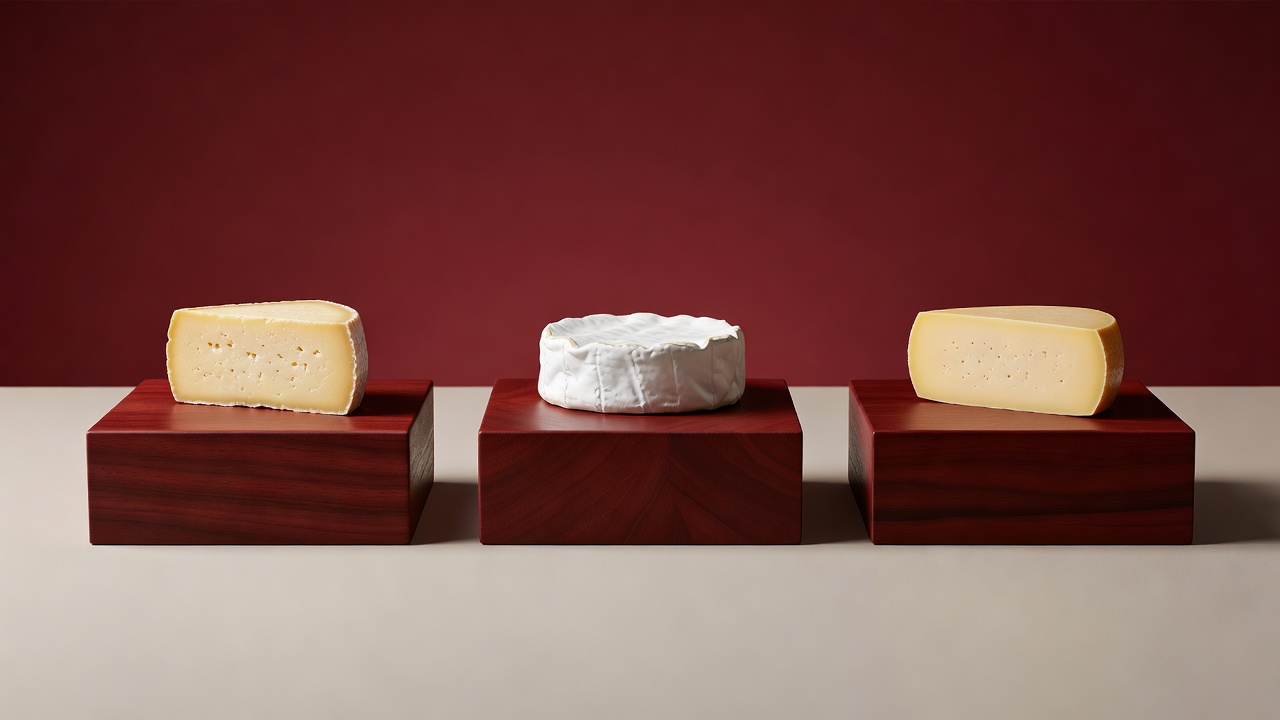
A tasting does not have to be a march from “mild” to “strong.” Choose a question that the actual cheeses can illuminate. Comté and Gruyère AOP might introduce the relationship between texture and maturation. Brie de Meaux and Camembert de Normandie can open a discussion about protected names and surface-ripened families. Their resemblance should invite comparison, not erase the differences in specification or individual production.
A second sequence might follow milk and region: Queso Manchego from La Mancha, Pecorino Romano and a locally sourced goat’s cheese with a clearly recorded origin. Do not describe every sheep’s-milk cheese as tasting the same. Ask visitors what they notice in this portion: firmness, friability, salt perception, aroma and finish. These observations are contingent on the product and the moment of service.
Give the senses a quiet setting
Strong room fragrance, scented candles and aggressive cleaning-product residues can interfere with aroma. Bright reflections from polished surfaces can make labels difficult to read. Music and mechanical noise can force the host to speak loudly. Use controlled, comfortable light and an acoustic treatment that can coexist with hygiene requirements. The objective is not silence but an environment where a quiet observation can be heard.
Provide water and a simple way to pause between samples. Bread or crackers are optional tools, not neutral by definition; their ingredients and flavour matter. Place shared accompaniments so that visitors are not repeatedly reaching over another person’s plate. Consider individual service when it makes allergen management, accessibility or conversation easier. The table layout should support the intended group size without depending on perfect guest behaviour.
Portion with both story and safety in mind
A useful piece may include a transition from centre to rind where appropriate, but no universal cutting diagram suits every shape. Make the portioning method part of staff training. Use suitable, clean utensils and a process that manages cross-contamination. Follow the operator’s time and temperature controls; bringing cheese toward a preferred tasting condition is not permission for indefinite room-temperature display.
Keep the link between each portion and its source. A numbered plate can correspond to a short printed ledger with product name, region, milk and known producer. That record is more valuable than a dramatic but ambiguous label such as “the cave cheese.” Visitors should be able to revisit a comparison without asking the host to reconstruct the entire sequence from memory.
End with a traceable memory
Leave space for visitors to write their own words. “Nutty” or “grassy” can be useful sensory descriptions, but they are not laboratory findings and should not be presented as proof of provenance. A brief final conversation can distinguish what was observed from what the producer’s documentation verifies. This is where a tasting room becomes a learning space rather than a performance.
Provide a clear exit route and a place for used plates that does not cross the next group’s arrival. If products are sold, make pricing and product identification separate from the teaching material. The lasting impression should be confidence: visitors understand what they tasted, where the information came from and why the room was arranged to support that encounter.